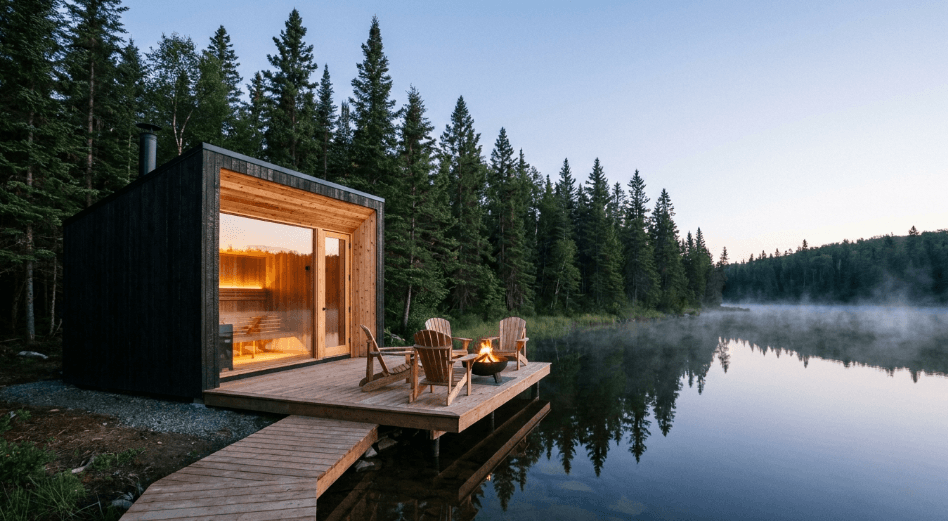
Western red cedar and heat-treated hemlock are the two most common wood choices for a small outdoor sauna, and neither is the clearly better option across the board. Cedar carries natural oils that resist rot and insects without any processing, has a lighter weight that helps with a compact build, and brings the strong, familiar sauna aroma most people expect. Heat-treated hemlock gets comparable rot resistance through a thermal process rather than natural chemistry, typically costs 15 to 30 percent less per board foot, and has a milder, almost toasted scent that some owners actually prefer in a small, enclosed cabin.
What Makes Western Red Cedar the Traditional Choice?
Cedar’s reputation in sauna building comes down to a handful of properties baked into the wood itself. It contains natural oils and extractives that resist decay and insect damage without any chemical treatment, which matters for an exterior surface exposed to rain and sun year-round. It is also one of the lighter softwoods used in construction, which keeps a barrel or cabin’s shipping weight and structural load lower, a real advantage on a small lot where the sauna might sit on a simple gravel pad rather than a poured foundation. The strong, resinous aroma that fills a cedar sauna as it heats is the other reason builders default to it, since that smell is part of what many people associate with the experience in the first place.
What Is Heat-Treated Hemlock, and How Does It Compare?
Heat-treated hemlock starts as a lower-cost softwood and goes through a thermal modification process, typically several hours at temperatures well above 350 degrees Fahrenheit in a low-oxygen kiln, that changes the wood’s cell structure at a chemical level. The process reduces the wood’s capacity to absorb moisture, which is the main driver of rot and swelling, so the finished board resists decay in a way raw hemlock never would on its own. It also darkens the wood to a warm, even brown that some owners find more attractive than pale cedar, and it tends to be more dimensionally stable, meaning less swelling and shrinking as humidity changes through the seasons. The tradeoff is a milder scent, since the same heat process that improves durability also drives off much of the wood’s natural aromatic compounds.
Weathering: Which Wood Ages Better Outdoors?
Left unsealed, both woods weather to a similar silvery gray patina within a year or two of sun and rain exposure, and neither one’s structural performance depends on keeping that original color. Cedar’s natural oils give it a slight edge in raw rot resistance over decades of exposure, particularly in wet, coastal, or high-humidity climates. Heat-treated hemlock’s dimensional stability is its counterpart advantage, since it resists the warping and surface checking that can develop in wood that swells and shrinks repeatedly, which matters more in climates with big seasonal humidity swings than in a mild, stable one. In practice, a sealed, well-maintained exterior of either wood should look presentable for well over a decade before it needs more than routine resealing.
Does Weight Matter for a Small-Footprint Build?
Cedar is one of the lighter construction softwoods available, and that lighter weight carries through to a finished barrel or cabin, which can matter on a small lot where the unit sits on a simple gravel pad rather than a poured foundation rated for heavy point loads. Heat-treated hemlock is somewhat denser once the thermal process finishes, so a hemlock cabin of the same dimensions typically weighs more than a cedar equivalent, though the difference rarely changes what kind of pad a small two to three person unit needs. Delivery cost can shift slightly with weight too, since heavier units sometimes cost a bit more to ship depending on distance from the manufacturer. Neither wood’s weight is a dealbreaker for a compact build, but it is worth asking a specific manufacturer for finished unit weight before assuming a lighter gravel pad will do the job.
What Does the Price Difference Look Like on a Small Build?
For a compact two to three person sauna, the wood species alone typically shifts total unit price by several hundred dollars, since heat-treated hemlock generally runs 15 to 30 percent cheaper per board foot than clear-grade western red cedar. On a small footprint that difference is smaller in absolute dollars than it would be on a large cabin, simply because there is less lumber involved overall, but it is still often enough to fund an upgraded heater or a nicer bench layout if the budget is fixed. Buyers comparing current models built from each wood species, including how the price difference plays out on finished units rather than raw lumber, can look at what SweatDecks and other specialty retailers currently carry to see the real-world spread.
Does Wood Choice Affect the Heat and Smell Inside?
Both woods perform similarly as insulators and hold heat well once the cabin comes up to temperature, so wood species is not really a factor in how hot a small sauna gets or how long it takes to heat. The bigger difference is sensory. Cedar’s strong, resinous scent intensifies noticeably as the wood warms, which is part of the traditional sauna experience for most people but can feel overpowering to a few, especially in a tightly sealed small cabin with limited airflow. Heat-treated hemlock’s milder, toasted aroma is a deliberate selling point for buyers who want the visual warmth and durability of a treated wood without a strong smell dominating the space.
What Does the Research Say About Sauna Use Generally?
Wood species does not change the health picture of sauna use, but it is worth knowing what the research base actually covers before investing in either build. A 2023 review in Mayo Clinic Proceedings summarized cardiovascular associations tied to regular Finnish-style sauna bathing alongside other lifestyle factors like physical activity, and an earlier review in the same journal reported broadly similar associations with lower cardiovascular event rates among frequent sauna users. A separate review in The American Journal of Medicine covered both the reported benefits and the contraindications worth knowing, including caution for people with unstable cardiovascular conditions or who are pregnant. These are observational, population-level associations rather than proof that any individual sauna session changes a specific health outcome, and none of it depends on whether the cabin is built from cedar or hemlock.
Frequently Asked Questions
Is cedar or heat-treated hemlock better for an outdoor sauna? Cedar resists rot naturally and carries a stronger aroma, while heat-treated hemlock gets similar rot resistance through processing and usually costs less. The choice comes down to budget and how much scent you want inside.
Does heat-treated hemlock smell different from cedar? Yes. The heat treatment that adds rot resistance also drives off most of the wood’s natural scent, leaving a mild, slightly toasted smell rather than cedar’s strong aroma.
Which wood weathers better outdoors, cedar or hemlock? Both weather to a gray patina if unsealed and hold up well with proper sealing. Cedar has a slight natural edge on rot resistance; hemlock’s stability resists warping better through humidity swings.
Is heat-treated hemlock as durable as cedar for a sauna? Yes, for a well-built unit. The thermal process reduces the wood’s ability to absorb moisture, so a properly treated hemlock sauna can last as long as a cedar one with equivalent care.
References
- Does the Combination of Finnish Sauna Bathing and Other Lifestyle Factors Confer Additional Health Benefits? A Review of the Evidence, Mayo Clinic Proceedings, 2023
- Cardiovascular and Other Health Benefits of Sauna Bathing: A Review of the Evidence, Mayo Clinic Proceedings, 2018
- Benefits and risks of sauna bathing, The American Journal of Medicine, 2001
- By Nathan Prescott